
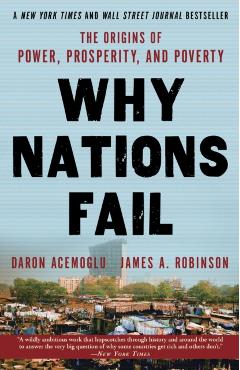
Why Nations Fail: The Origins of Power, Prosperity, and Poverty
Fii primul care dă o notă
Adaugă într-o listă
Despre carte
Based on 15 years of original research, Acemoglu and Robinson marshal extraordinary historical evidence from the Roman Empire, the Mayan city-states, medieval Venice, the Soviet Union, Latin America, England, Europe, the United States, and Africa to build a new theory of political economy with great relevance for the big questions of today. Brilliant and engagingly written, Why Nations Fail answers the question that has stumped the experts for centuries: Why are some nations rich and others poor, divided by wealth and poverty, health and sickness, food and famine? Is it culture, the weather, geography? Perhaps ignorance of what the right policies are? Simply, no. None of these factors is either definitive or destiny. Otherwise, how to explain why Botswana has become one of the fastest growing countries in the world, while other African nations, such as Zimbabwe, the Congo, and Sierra Leone, are mired in poverty and violence? Daron Acemoglu and James Robinson conclusively show that it is man-made political and economic institutions that underlie economic success (or lack of it). Korea, to take just one of their fascinating examples, is a remarkably homogeneous nation, yet the people of North Korea are among the poorest on earth while their brothers and sisters in South Korea are among the richest. The south forged a society that created incentives, rewarded innovation, and allowed everyone to participate in economic opportunities. The economic success thus spurred was sustained because the government became accountable and responsive to citizens and the great mass of people. Sadly, the people of the north have endured decades of famine, political repression, and very different economic institutions--with no end in sight. The differences between the Koreas is due to the politics that created these completely different institutional trajectories. Based on fifteen years of original research Acemoglu and Robinson marshall extraordinary historical evidence from the Roman Empire, the Mayan city-states, medieval Venice, the Soviet Union, Latin America, England, Europe, the United States, and Africa to build a new theory of political economy with great relevance for the big questions of today, including: - China has built an authoritarian growth machine. Will it continue to grow at such high speed and overwhelm the West? - Are America's best days behind it?
Citește-o cu alții
Fă un club în jurul ei: o împărțiți pe etape, vă bifați progresul și discutați fără spoilere.
Pornește un club cu cartea astaUnde o cumperi
Caut-o și la Cărturești
Prețuri verificate azi
Linkuri afiliate: susții comunitatea fără costuri extra.
De la cititori
Niciun cititor nu vinde acum cartea asta.
Ai cartea? Vinde exemplarul tăuRecenzii
Autentifică-te ca să scrii o recenzie →Nicio recenzie încă. A ta poate fi prima! ✍️
De Daron Acemoglu
Toate cărțile autorului
De ce esueaza natiunile. Originile puterii, ale prosperitatii si ale saraciei
James A. Robinson, Daron Acemoglu
de la 33,75 lei
3 magazine

Putere și progres
Daron Acemoglu, Simon Johnson
de la 104,66 lei
2 magazine

Coridorul ingust
Daron Acemoglu, James A. Robinson
de la 89,86 lei
2 magazine

De ce eșuează națiunile. Vol. 128
Daron Acemoglu, James A. Robinson
de la 44,99 lei
1 magazin

De ce eșuează națiunile. Originile puterii, ale prosperității și ale sărăciei. Vol. 57
Daron Acemoglu, James A. Robinson
de la 49,99 lei
1 magazin

Putere si progres. Lupta noastra din ultimul mileniu pentru tehnologie si progres
Daron Acemoglu
de la 99 lei
1 magazin
Why Nations Fail
Daron Acemoglu, James A. Robinson
de la 84,18 lei
2 magazine

The Narrow Corridor
Daron Acemoglu, James A. Robinson
de la 92 lei
1 magazin

Power and Progress: Our Thousand-Year Struggle Over Technology and Prosperity
Daron Acemoglu
de la 128,29 lei
1 magazin

What Happened to Liberal Democracy?
Daron Acemoglu
de la 99 lei
1 magazin
Din același raft: Științe politice · Știință & Tehnologie
Tot raftul
The Mass Psychology of Fascism
Wilhelm Reich
de la 106 lei
2 magazine

If Destruction Be Our Lot
Abraham Lincoln
de la 43,99 lei
2 magazine

The Heritage Guide to the Constitution: Fully Revised Third Edition
Josh Blackman
de la 334,75 lei
1 magazin

When Democracy Breaks: Studies in Democratic Erosion and Collapse, from Ancient Athens to the Present Day
Archon Fung
de la 291,47 lei
1 magazin

We've Been Here Before: How Rebellion and Activism Have Always Sustained America
Michael I. Days
de la 129,54 lei
1 magazin

A More Perfect Party: The Night Shirley Chisholm and Diahann Carroll Reshaped Politics
Juanita Tolliver
de la 161,82 lei
1 magazin

Wuhan: How the Covid-19 Outbreak in China Spiraled Out of Control
Dali L. Yang
de la 259,11 lei
1 magazin

Shapeshifting for Law Enforcement CNT/HNT: Effective Scenario Training for Crisis/Hostage Negotiation Teams
Ellis Amdur
de la 393,95 lei
1 magazin

How to Stand Up to a Dictator: The Fight for Our Future
Maria Ressa
de la 111,55 lei
1 magazin

Beyond Control: Drug Prohibition, Gun Regulation, and the Search for Sensible Alternatives
Jacob Sullum
de la 178,26 lei
1 magazin