
The Oxford Handbook of Polling and Survey Methods
Lonna Rae Atkenson, R. Michael Alvarez
Fii primul care dă o notă
Adaugă într-o listă
Despre carte
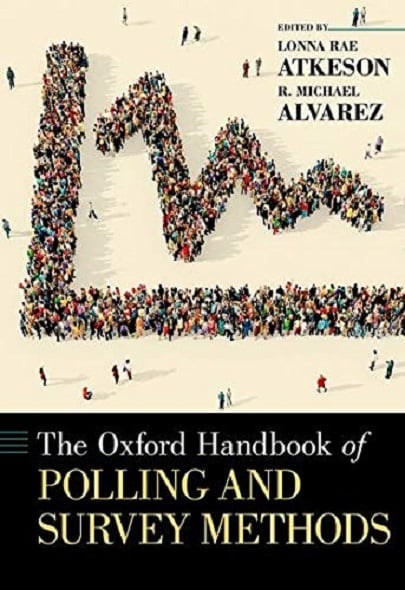
The methodologies used to study public opinion are now in flux. The primary polling method of the last half-century, the telephone survey, is rapidly becoming obsolete as a data collection method. At the same time, new methods of contacting potential respondents and obtaining their response are appearing, providing a variety of options for scholars and practitioners. Generally speaking, we are moving from a polling world that was largely interviewer driven over thephone and face-to-face to predominantly interviewer driven self-administered poll environments, New methods of data collection, however, must still deal with fundamental questions to polling methodology and total survey error including sampling, selection bias, non-response error, poststratificationweighting, and questionnaire design features.The Oxford Handbook on Polling and Survey Methods brings together a unique mixture of academics and practitioners, from various backgrounds, academic disciplines, and experiences. In some sense, this is reflective of the interdisciplinary nature of the polling and survey industry: polls and surveys are widely used in academia, government, and the private sector. Designing, implementing, and analyzing high quality, accurate, and cost-effective polls and surveys requires a combination ofskills and methodological perspectives. Despite the well-publicized issues that have cropped up in recent political polling, a great deal is known today about how to collect high quality polling and survey data even in complex and difficult environments. Divided into four main sections, the Handbook draws onthe existing research and explores data collection methods. It then addresses data analysis and the methods available for combining polling data with other types of data. The next section covers analytic issues, including the new approaches to studying public opinion (ie social media, the analysis of open-ended questions using text analytic tools, and data imputation). The final section focuses on the presentation of polling results, an area where there is a great deal of innovation.A comprehensive overview of the topic, this volume highlights current polling trends provides ideas for the development of new and better approaches for measuring, modeling, and visualizing public opinion and social behavior.
Citește-o cu alții
Fă un club în jurul ei: o împărțiți pe etape, vă bifați progresul și discutați fără spoilere.
Pornește un club cu cartea astaUnde o cumperi
Caut-o și la Libris
Prețuri verificate azi
Linkuri afiliate: susții comunitatea fără costuri extra.
De la cititori
Niciun cititor nu vinde acum cartea asta.
Ai cartea? Vinde exemplarul tăuRecenzii
Autentifică-te ca să scrii o recenzie →Nicio recenzie încă. A ta poate fi prima! ✍️
Din același raft: Carte străină
Tot raftul
The Thirty-Nine Steps
John Buchan
de la 19,38 lei
3 magazine

The Memoirs of Sherlock Holmes
Sir Arthur Conan Doyle
de la 48,16 lei
3 magazine

Great Expectations
Charles Dickens
de la 13,16 lei
3 magazine

On the Origin of Species
Charles Darwin
de la 53,95 lei
3 magazine

Tom Jones
Henry Fielding
de la 35 lei
3 magazine

Richard II
William Shakespeare
de la 13,16 lei
3 magazine

Journey to the Centre of the Earth
Jules Verne
de la 13,16 lei
3 magazine

The Professor
Charlotte Brontë
de la 25 lei
3 magazine

Days
Florin Mitroi
de la 139 lei
3 magazine

Romanian phrasebook
Linghea
de la 32,90 lei
3 magazine