
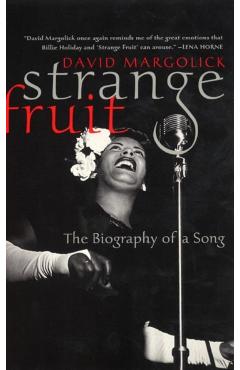
Strange Fruit: Billie Holiday and the Biography of a Song
Fii primul care dă o notă
Adaugă într-o listă
Despre carte
Recorded by jazz legend Billie Holiday in 1939, Strange Fruit is considered the first significant song of the civil rights movement and the first musical assault against racial lynchings. The author discusses his revealing account of the song, chronicles the civil rights movement from the 1930s on, and profiles Holiday and songwriter, Abel Meeropol. Photos. Learn the story behind the song performed by Andra Day in United States vs. Billie Holiday now on Hulu Recorded by jazz legend Billie Holiday in 1939, Strange Fruit is considered the first significant song of the Civil Rights movement and the first direct assault against racial lynchings in the South. First sung in New York's Café Society, these revolutionary lyrics have taken up a life of their own, as David Margolick discusses in his revealing account of the song and the struggle it came to personify. Voted the Song of the Century by Time, Strange Fruit is a searing evocation of lynching. And when Billie Holiday sang it, she held audiences in rapt attention, moving some to tears, others to anger, and all to a heightened awareness of the racist violence that was still, nearly a century after the Civil War, taking the lives of African Americans. Now, David Margolick's account cuts away the myths that have grown up around both Holiday and her most famous song, allowing readers to discover the true origins of Strange Fruit and the circuitous paths it took to the center of a nation's conscience. Margolick establishes the political and cultural context that surrounded Strange Fruit in 1939--a year in which there were three recorded lynchings and suspicion of many others, and which saw the publication of Gone with the Wind--and traces the song's journey through the red-baiting 50s and the incipient Civil Rights movement of the 60s, right up to the reverence it still inspires today. Along the way, Margolick includes commentary and reaction to the song from black and white audiences of different eras, and writers and musicians as varied as Lena Horne, Paul Robeson, Pauline Kael, Charles Mingus, Cassandra Wilson, Maya Angelou, among others. Exploring the intricate nexus between jazz, race, and politics, Strange Fruit opens a window onto an extraordinary song, the woman who sang it, and the role it played in our culture's evolving consciousness of racism.
Citește-o cu alții
Fă un club în jurul ei: o împărțiți pe etape, vă bifați progresul și discutați fără spoilere.
Pornește un club cu cartea astaUnde o cumperi
Caut-o și la Cărturești
Prețuri verificate azi
Linkuri afiliate: susții comunitatea fără costuri extra.
De la cititori
Niciun cititor nu vinde acum cartea asta.
Ai cartea? Vinde exemplarul tăuRecenzii
Autentifică-te ca să scrii o recenzie →Nicio recenzie încă. A ta poate fi prima! ✍️
Din același raft: Biografii · Biografii & Memorii
Tot raftul
The Name of This Band Is R.E.M.: A Biography
Peter Ames Carlin
de la 117,18 lei
1 magazin
Iggy Pop: Open Up and Bleed: A Biography
Paul Trynka
de la 100,44 lei
1 magazin
The Life of Christ
Reverend Fulton J. Sheen
de la 43,07 lei
1 magazin
Fast Girl: A Life Spent Running from Madness
Suzy Favor Hamilton
de la 113,03 lei
1 magazin
Finding Freedom: A Cook's Story; Remaking a Life from Scratch
Erin French
de la 123,06 lei
1 magazin
A Few Words in Defense of Our Country: The Biography of Randy Newman
Robert Hilburn
de la 189,72 lei
1 magazin

President Without a Party: The Life of John Tyler
Christopher J. Leahy
de la 250,82 lei
1 magazin

Finding Me: A Decade of Darkness, a Life Reclaimed: A Memoir of the Cleveland Kidnappings
Michelle Knight
de la 105,97 lei
1 magazin
Jim Henson: The Biography
Brian Jay Jones
de la 133,92 lei
1 magazin
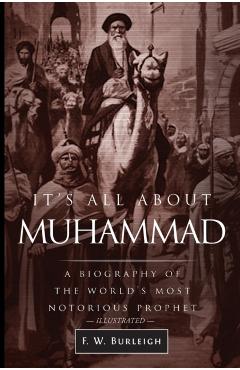
It's All About Muhammad: A Biography of the World's Most Notorious Prophet
F. W. Burleigh
de la 140,91 lei
1 magazin