
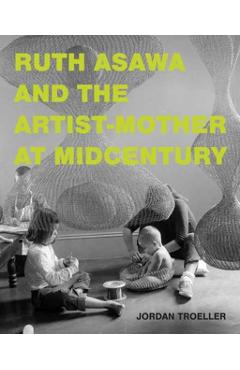
Ruth Asawa and the Artist-Mother at Midcentury
Fii primul care dă o notă
Adaugă într-o listă
Despre carte
How a group of artist-mothers in postwar San Francisco refused the centuries-old belief that a woman could not make art while also raising children. For most of modern history, to be an artist and a mother was to embody a contradiction in terms. This awful dichotomy, as painter Alice Neel put it, pitted artmaking against caretaking and argued that the best art was made at the expense of family and futurity. But in San Francisco in the 1950s and 60s, a group of artists gathered around Ruth Asawa (1926-2013) began to reject this dominant narrative. In Ruth Asawa and the Artist-Mother at Midcentury, Jordan Troeller analyzes this remarkable moment. Insisting that their labor as mothers fueled their labor as artists, these women redefined key aesthetic concerns of their era, including autonomy, medium-specificity, and originality. Delving into the archive, where the traces of motherhood have not yet been erased from official history, Troeller reveals Ruth Asawa's personal and professional dialogue with several other artist-mothers--including Merry Renk, Imogen Cunningham, and Sally Woodbridge. For these women, motherhood was not an essentialized identity, but rather a means to reimagine the terms of artmaking, outside of the patriarchal policing of reproduction. This project unfolded in three broad areas, which also structure the book's chapters: domesticity and decoration; metaphors for creativity; and maternal labor in the public sphere, especially in the public schools. Drawing on queer theory and feminist writings, Troeller argues that in belatedly accounting for the figure of the artist-mother, art history must reckon with an emergent paradigm of artmaking, one predicated on reciprocity, caretaking, and futurity. How a group of artist-mothers in postwar San Francisco refused the centuries-old belief that a woman could not make art while also raising children. For most of modern history, to be an artist and a mother was to embody a contradiction in terms. This awful dichotomy, as painter Alice Neel put it, pitted artmaking against caretaking and argued that the best art was made at the expense of family and futurity. But in San Francisco in the 1950s and 1960s, a group of artists gathered around Ruth Asawa (1926-2013) began to reject this dominant narrative. In Ruth Asawa and the Artist-Mother at Midcentury, Jordan Troeller analyzes this remarkable moment.
Citește-o cu alții
Fă un club în jurul ei: o împărțiți pe etape, vă bifați progresul și discutați fără spoilere.
Pornește un club cu cartea astaUnde o cumperi
Caut-o și la Cărturești
Prețuri verificate azi
Linkuri afiliate: susții comunitatea fără costuri extra.
De la cititori
Niciun cititor nu vinde acum cartea asta.
Ai cartea? Vinde exemplarul tăuRecenzii
Autentifică-te ca să scrii o recenzie →Nicio recenzie încă. A ta poate fi prima! ✍️
Din același raft: Artă & fotografie · Sănătate & Lifestyle
Tot raftul
Great Paintings
DK Publishing
de la 136,54 lei
3 magazine
Timelines of Art
Dk
de la 176 lei
2 magazine
Ways of Seeing
John Berger
de la 71,22 lei
2 magazine
The Face Magazine: Culture Shift
Sabina Jaskot-gill
de la 223,20 lei
2 magazine

Sonia Delaunay
Sonia Delaunay
de la 175 lei
2 magazine
Out of the Box
Tom Buchanan, Sarah Lea
de la 279 lei
2 magazine

Sinaia, land of the Elites. Architecture and history
Dan Manea
de la 120,75 lei
2 magazine

The Rolling Stones: Icons
Acc Art Books Ltd
de la 388,80 lei
2 magazine
Picasso in Fontainebleau
Pablo Picasso
de la 362,70 lei
2 magazine

Understanding Perspective (the Urban Sketching Handbook)
Stephanie Bower
de la 105,97 lei
2 magazine