
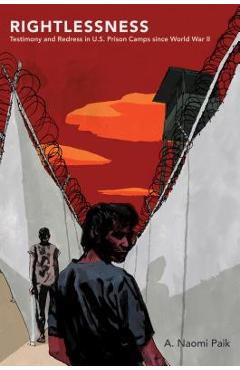
Rightlessness: Testimony and Redress in U.S. Prison Camps Since World War II
Fii primul care dă o notă
Adaugă într-o listă
Despre carte
In this bold book, A. Naomi Paik grapples with the history of U.S. prison camps that have confined people outside the boundaries of legal and civil rights. Removed from the social and political communities that would guarantee fundamental legal protections, these detainees are effectively rightless, stripped of the right even to have rights. Rightless people thus expose an essential paradox: while the United States purports to champion inalienable rights at home and internationally, it has built its global power in part by creating a regime of imprisonment that places certain populations perceived as threats beyond rights. The United States' status as the guardian of rights coincides with, indeed depends on, its creation of rightlessness. Yet rightless people are not silent. Drawing from an expansive testimonial archive of legal proceedings, truth commission records, poetry, and experimental video, Paik shows how rightless people use their imprisonment to protest U.S. state violence. She examines demands for redress by Japanese Americans interned during World War II, testimonies of HIV-positive Haitian refugees detained at Guantanamo in the early 1990s, and appeals by Guantanamo's enemy combatants from the War on Terror. In doing so, she reveals a powerful ongoing contest over the nature and meaning of the law, over civil liberties and global human rights, and over the power of the state in people's lives. In this bold book, A. Naomi Paik grapples with the history of U.S. prison camps that have confined people outside the boundaries of legal and civil rights. Removed from the social and political communities that would guarantee fundamental legal protections, these detainees are effectively rightless, stripped of the right even to have rights. Rightless people thus expose an essential paradox: while the United States purports to champion inalienable rights at home and internationally, it has built its global power in part by creating a regime of imprisonment that places certain populations perceived as threats beyond rights. The United States' status as the guardian of rights coincides with, indeed depends on, its creation of rightlessness. Yet rightless people are not silent. Drawing from an expansive testimonial archive of legal proceedings, truth commission records, poetry, and experimental video, Paik shows how rightless people use their imprisonment to protest U.S. state violence.
Citește-o cu alții
Fă un club în jurul ei: o împărțiți pe etape, vă bifați progresul și discutați fără spoilere.
Pornește un club cu cartea astaUnde o cumperi
Caut-o și la Cărturești
Prețuri verificate azi
Linkuri afiliate: susții comunitatea fără costuri extra.
De la cititori
Niciun cititor nu vinde acum cartea asta.
Ai cartea? Vinde exemplarul tăuRecenzii
Autentifică-te ca să scrii o recenzie →Nicio recenzie încă. A ta poate fi prima! ✍️
Din același raft: Științe politice · Știință & Tehnologie
Tot raftul
A Flower Traveled in My Blood: The Incredible True Story of the Grandmothers Who Fought to Find a Stolen Generation of Children
Haley Cohen Gilliland
de la 97,14 lei
1 magazin

War on Peace: The End of Diplomacy and the Decline of American Influence
Ronan Farrow
de la 105,74 lei
1 magazin

Swimming Against the Current: Fighting for Common Sense in a World That's Lost Its Mind
Riley Gaines
de la 105,97 lei
1 magazin

The Impostors: How Republicans Quit Governing and Seized American Politics
Steve Benen
de la 124,93 lei
1 magazin

Prexit: Forging Puerto Rico's Path to Sovereignty
Javier A. Hernandez
de la 125,48 lei
1 magazin

The Right of the People: Democracy and the Case for a New American Founding
Osita Nwanevu
de la 172,98 lei
1 magazin

The Iron Triangle: Inside the Liberal Democrat Plan to Use Race to Divide Christians and America in their Quest for Power and How We Can
Vince Everett Ellison
de la 178,26 lei
1 magazin

Democracy - The God That Failed: The Economics and Politics of Monarchy, Democracy and Natural Order
Hans-hermann Hoppe
de la 610,93 lei
1 magazin

Washington Bullets: A History of the Cia, Coups, and Assassinations
Vijay Prashad
de la 167,87 lei
1 magazin

Unti Nonfiction - Anon9780063061194
de la 178,56 lei
1 magazin