
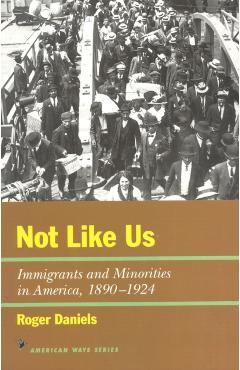
Not Like Us: Immigrants and Minorities in America, 1890-1924
Fii primul care dă o notă
Adaugă într-o listă
Despre carte
In the thirty-five years after 1890, more than 20 million immigrants came to the United States-a greater number than in any comparable period, before or since. They were often greeted in hostile fashion, a reflection of American nativism that by the 1890s was already well developed. In this analytical narrative, Roger Daniels examines the condition of immigrants, Native Americans, and African Americans during a period of supposed progress for American minorities. He shows that they experienced as much repression as advance. Not Like Us opens by considering the Chinese Exclusion Act of 1882, the hinge on which U.S. immigration policy turned and a symbol of the unfriendly climate toward minorities that would prevail for decades. Mr. Daniels continues the story through the 1890s, the so-called Progressive Era, the opportunities and conflicts arising out of World War I, and the tribal twenties, when nativism and xenophobia dominated American society. An epilogue points out gains and losses since the 1924 National Origins Act. Throughout Mr. Daniels's focus is on legislation, judicial decisions, mob violence, and the responses of minority groups. The record is scarcely one of unalloyed progress. In the thirty-five years after 1890, more than 20 million immigrants came to the United States--a greater number than in any comparable period, before or since. They were often greeted in hostile fashion, a reflection of American nativism that by the 1890s was already well developed. In this analytical narrative, Roger Daniels examines the condition of immigrants, Native Americans, and African Americans during a period of supposed progress for American minorities. He shows that they experienced as much repression as advance. Not Like Us opens by considering the Chinese Exclusion Act of 1882, the hinge on which U.S. immigration policy turned and a symbol of the unfriendly climate toward minorities that would prevail for decades. Mr. Daniels continues the story through the 1890s, the so-called Progressive Era, the opportunities and conflicts arising out of World War I, and the tribal twenties, when nativism and xenophobia dominated American society. An epilogue points out gains and losses since the 1924 National Origins Act. Throughout Mr. Daniels's focus is on legislation, judicial decisions, mob violence, and the responses of minority groups.
Citește-o cu alții
Fă un club în jurul ei: o împărțiți pe etape, vă bifați progresul și discutați fără spoilere.
Pornește un club cu cartea astaUnde o cumperi
Caut-o și la Cărturești
Prețuri verificate ieri
Linkuri afiliate: susții comunitatea fără costuri extra.
De la cititori
Niciun cititor nu vinde acum cartea asta.
Ai cartea? Vinde exemplarul tăuRecenzii
Autentifică-te ca să scrii o recenzie →Nicio recenzie încă. A ta poate fi prima! ✍️
De Roger Daniels
Toate cărțile autorului

Din același raft: Istorie
Tot raftul
Timelines of World War II
Dk
de la 176 lei
2 magazine

1968: The Year That Rocked the World
Mark Kurlansky
de la 82,94 lei
2 magazine

Selected Works 1990–2025
de la 60 lei
2 magazine

Visions of Medieval Castles
Sabina Madgearu
de la 70,01 lei
2 magazine

A Short Illustrated History of Romanians
Ioan-Aurel Pop
de la 69,90 lei
2 magazine

In the Old Bucharest With Mircea Diaconu
Mircea Diaconu
de la 16,80 lei
2 magazine

The Crusades Through Arab Eyes
Amin Maalouf
de la 111,60 lei
2 magazine

Fire and fury
Michael Wolff
de la 89 lei
2 magazine

Homo Deus: A Brief History of Tomorrow
Yuval Noah Harari
de la 71,41 lei
2 magazine

The Mythology Book
de la 122,71 lei
2 magazine