
Adaugă într-o listă
Despre carte
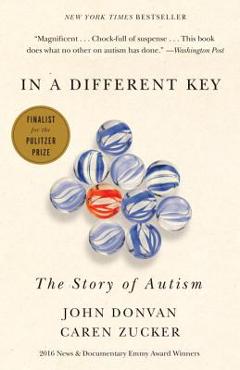
Finalist for the 2017 Pulitzer Prize in General Nonfiction An extraordinary narrative history of autism: the riveting story of parents fighting for their children 's civil rights; of doctors struggling to define autism; of ingenuity, self-advocacy, and profound social change. Nearly seventy-five years ago, Donald Triplett of Forest, Mississippi, became the first child diagnosed with autism. Beginning with his family's odyssey, In a Different Key tells the extraordinary story of this often misunderstood condition, and of the civil rights battles waged by the families of those who have it. Unfolding over decades, it is a beautifully rendered history of ordinary people determined to secure a place in the world for those with autism--by liberating children from dank institutions, campaigning for their right to go to school, challenging expert opinion on what it means to have autism, and persuading society to accept those who are different. It is the story of women like Ruth Sullivan, who rebelled against a medical establishment that blamed cold and rejecting refrigerator mothers for causing autism; and of fathers who pushed scientists to dig harder for treatments. Many others played starring roles too: doctors like Leo Kanner, who pioneered our understanding of autism; lawyers like Tom Gilhool, who took the families' battle for education to the courtroom; scientists who sparred over how to treat autism; and those with autism, like Temple Grandin, Alex Plank, and Ari Ne'eman, who explained their inner worlds and championed the philosophy of neurodiversity. This is also a story of fierce controversies--from the question of whether there is truly an autism epidemic, and whether vaccines played a part in it; to scandals involving facilitated communication, one of many treatments that have proved to be blind alleys; to stark disagreements about whether scientists should pursue a cure for autism. There are dark turns too: we learn about experimenters feeding LSD to children with autism, or shocking them with electricity to change their behavior; and the authors reveal compelling evidence that Hans Asperger, discoverer of the syndrome named after him, participated in the Nazi program that consigned disabled children to death.
Citește-o cu alții
Fă un club în jurul ei: o împărțiți pe etape, vă bifați progresul și discutați fără spoilere.
Pornește un club cu cartea astaUnde o cumperi
Caut-o și la Cărturești
Prețuri verificate azi
Linkuri afiliate: susții comunitatea fără costuri extra.
De la cititori
Niciun cititor nu vinde acum cartea asta.
Ai cartea? Vinde exemplarul tăuRecenzii
Autentifică-te ca să scrii o recenzie →Nicio recenzie încă. A ta poate fi prima! ✍️
Din același raft: Psihologie
Tot raftul
Eye tracking: A comprehensive guide to methods, paradigms, and measures
Richard Andersson
de la 405,59 lei
1 magazin

Unlearning Silence: How to Speak Your Mind, Unleash Talent, and Live More Fully
Elaine Lin Hering
de la 161,82 lei
1 magazin

Empaths and Highly Sensitive People: Harnessing the Power of Empathic Abilities and a Guide for the Highly Sensitive Person
Mari Silva
de la 184,09 lei
1 magazin

Warrior, Magician, Lover, King: A Guide to the Male Archetypes Updated for the 21st Century: A Guide to Men's Archetypes, Emotions, and the Developmen
Rod Boothroyd
de la 104,27 lei
1 magazin

Motivational Interviewing for Beginners: A Step-by-Step Guide to Creating Meaningful Change
Jane W. Harlow
de la 109,49 lei
1 magazin

The Emotion Amplifier Thesaurus: A Writer's Guide to Character Stress and Volatility (Second Edition)
Angela Ackerman
de la 132,45 lei
1 magazin

The Cognitive Behavioral Therapy Workbook for Panic Attacks
Elena Welsh
de la 89,23 lei
1 magazin

How to Analyze People: Dark Psychology - Dark Secrets to Analyze and Influence Anyone Using Body Language, Human Psychology, Subliminal Persu
James W. Williams
de la 105,85 lei
1 magazin

Flooded: A Brain-Based Guide to Help Children Regulate Emotions
Allison Edwards
de la 122,48 lei
1 magazin

Malady of the Mind: Schizophrenia and the Path to Prevention
Jeffrey A. Lieberman
de la 122,71 lei
1 magazin