
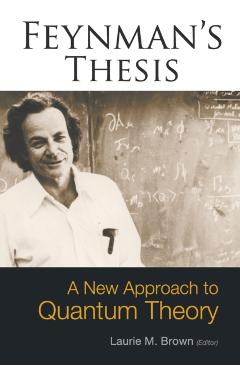
Feynman's Thesis: A New Approach to Quantum Theory
Fii primul care dă o notă
Despre carte
Richard Feynman's never previously published doctoral thesis formed the heart of much of his brilliant and profound work in theoretical physics. Entitled The Principle of Least Action in Quantum Mechanics, its original motive was to quantize the classical action-at-a-distance electrodynamics. Because that theory adopted an overall space-time viewpoint, the classical Hamiltonian approach used in the conventional formulations of quantum theory could not be used, so Feynman turned to the Lagrangian function and the principle of least action as his points of departure. The result was the path integral approach, which satisfied -- and transcended -- its original motivation, and has enjoyed great success in renormalized quantum field theory, including the derivation of the ubiquitous Feynman diagrams for elementary particles. Path integrals have many other applications, including atomic, molecular, and nuclear scattering, statistical mechanics, quantum liquids and solids, Brownian motion, and noise theory. It also sheds new light on fundamental issues like the interpretation of quantum theory because of its new overall space-time viewpoint. The present volume includes Feynman's Princeton thesis, the related review article Space-Time Approach to Non-Relativistic Quantum Mechanics [Reviews of Modern Physics 20 (1948), 367-387], Paul Dirac's seminal paper The Lagrangian in Quantum Mechanics'' [Physikalische Zeitschrift der Sowjetunion, Band 3, Heft 1 (1933)], and an introduction by Laurie M Brown.
Citește-o cu alții
Fă un club în jurul ei: o împărțiți pe etape, vă bifați progresul și discutați fără spoilere.
Pornește un club cu cartea astaUnde o cumperi
Caut-o și la Cărturești
Prețuri verificate ieri
Linkuri afiliate — susții comunitatea fără costuri extra.
Recenzii
Autentifică-te ca să scrii o recenzie →Nicio recenzie încă. A ta poate fi prima! ✍️