
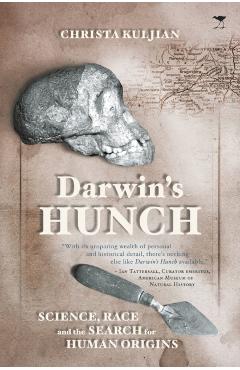
Darwin's Hunch: Science, Race, and the Search for Human Origins
Fii primul care dă o notă
Adaugă într-o listă
Despre carte
The announcement of the Homo naledi hominid fossils by Professor Lee Berger in September 2015 at Maropeng outside Johannesburg dominated the news and headlines for months internationally. The public reaction to the find indicated a fascination in the search for human origins, and that the concept of race and human evolution are linked in many people's minds. Christa Kuljian traces the history of South African palaeoanthropology and genetics research in order to make sense of science and race in the quest to understand human origins. Over time, the nature of the search has shifted and changed. What are we looking for after all? Darwin's hunch in 1871 was that humans evolved in Africa, but very few European scientists agreed. Raymond Dart wrote in Nature in February 1925 that the Taung Child Skull supported Darwin's theory. Dart believed he had found the missing link between apes and humans. Again, few scientists agreed. Over the past century, the search for human origins has been shaped by the changing social and political context. Reflecting colonial thinking, Raymond Dart followed the practice in the US and Europe of collecting human remains and characterising human skeletons into racial types. He thought that there was a Bushman racial type that might provide a clue to human evolution. In 1936, he led a Wits University expedition to the Kalahari to study this imaginary racial type. One of the people he met and measured was a young woman named /Keri-/Keri. She died two years later. Her body was embalmed and taken to Wits University where her skeleton became part of the Raymond Dart Skeleton Collection. The book uncovers the sad story of what happened to her remains. In addition to /Keri-/Keri, Kuljian introduces us to a range of people who were in the shadows of the well-known scientists. The book shows how Prime Minister Jan Smuts supported the search for human origins in the 1920s, 30s and 40s, how the concept of human evolution was opposed by the apartheid government, and how the post-1994 South African government and President Thabo Mbeki, with encouragement from Phillip Tobias, celebrated the fact that Africa is the Cradle of Humankind. Yet the search continues. In 1987, the publication of 'Mitochondrial DNA and Human Evolution' suggested that all living humans could trace their ancestry back to Africa 200,000 years ago. Many scientists and the general public in the West were slow to accept such a claim.
Citește-o cu alții
Fă un club în jurul ei: o împărțiți pe etape, vă bifați progresul și discutați fără spoilere.
Pornește un club cu cartea astaUnde o cumperi
Caut-o și la Cărturești
Prețuri verificate azi
Linkuri afiliate: susții comunitatea fără costuri extra.
De la cititori
Niciun cititor nu vinde acum cartea asta.
Ai cartea? Vinde exemplarul tăuRecenzii
Autentifică-te ca să scrii o recenzie →Nicio recenzie încă. A ta poate fi prima! ✍️
Din același raft: Istorie
Tot raftul
The Watchmaker's Daughter: The True Story of World War II Heroine Corrie Ten Boom
Larry Loftis
de la 122,71 lei
1 magazin

The Golden Road: How Ancient India Transformed the World
William Dalrymple
de la 128,34 lei
1 magazin

The Last Consolation Vanished: The Testimony of a Sonderkommando in Auschwitz
Zalmen Gradowski
de la 129,60 lei
1 magazin

The Chancellor's Mansion: A Renovation Story of Family, Home, History, and Mystery
Jamie Arty
de la 161,77 lei
1 magazin

Wide Awake: The Forgotten Force That Elected Lincoln and Spurred the Civil War
Jon Grinspan
de la 162 lei
1 magazin

Glorious Country: How the Artist Frederic Church Brought the World to America and America to the World
Victoria Johnson
de la 162 lei
1 magazin

Brooklynites: The Remarkable Story of the Free Black Communities That Shaped a Borough
Prithi Kanakamedala
de la 167,40 lei
1 magazin

A History of Goblins
Matt King
de la 175,43 lei
1 magazin

The Struggle for Taiwan: A History of America, China, and the Island Caught Between
Sulmaan Wasif Khan
de la 178,56 lei
1 magazin

Hip-Hop Is History
Questlove
de la 194,40 lei
1 magazin