
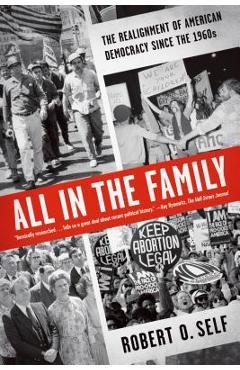
All in the Family: The Realignment of American Democracy Since the 1960s
Fii primul care dă o notă
Adaugă într-o listă
Despre carte
Award-winning historian Self is the first to recognize that the many separate threads of a great political realignment--from civil rights to women's rights, from the antiwar movement to the silent majority, from the abortion wars to gay marriage, from health care to welfare reform--all run through the politicized modern American family. In the 1960s, Lyndon Johnson's Great Society and War on Poverty promised an array of federal programs to assist working-class families. In the 1980s, Ronald Reagan declared the GOP the party of family values and promised to keep government out of Americans' lives. Again and again, historians have sought to explain the nation's profound political realignment from the 1960s to the 2000s, five decades that witnessed the fracturing of liberalism and the rise of the conservative right. The award-winning historian Robert O. Self is the first to argue that the separate threads of that realignment--from civil rights to women's rights, from the antiwar movement to Nixon's silent majority, from the abortion wars to gay marriage, from the welfare state to neoliberal economic policies--all ran through the politicized American family. Based on an astonishing range of sources, All in the Family rethinks an entire era. Self opens his narrative with the Great Society and its assumption of a white, patriotic, heterosexual man at the head of each family. Soon enough, civil rights activists, feminists, and gay rights activists, animated by broader visions of citizenship, began to fight for equal rights, protections, and opportunities. Led by Pauli Murray, Gloria Steinem, Harvey Milk, and Shirley Chisholm, among many others, they achieved lasting successes, including Roe v. Wade, antidiscrimination protections in the workplace, and a more inclusive idea of the American family. Yet the establishment of new rights and the visibility of alternative families provoked, beginning in the 1970s, a furious conservative backlash. Politicians and activists on the right, most notably George Wallace, Phyllis Schlafly, Anita Bryant, and Jerry Falwell, built a political movement based on the perceived moral threat to the traditional family. Self writes that family values conservatives in fact paved the way for fiscal conservatives, who shared a belief in liberalism's invasiveness but lacked a populist message.
Citește-o cu alții
Fă un club în jurul ei: o împărțiți pe etape, vă bifați progresul și discutați fără spoilere.
Pornește un club cu cartea astaUnde o cumperi
Caut-o și la Cărturești
Prețuri verificate azi
Linkuri afiliate: susții comunitatea fără costuri extra.
De la cititori
Niciun cititor nu vinde acum cartea asta.
Ai cartea? Vinde exemplarul tăuRecenzii
Autentifică-te ca să scrii o recenzie →Nicio recenzie încă. A ta poate fi prima! ✍️
Din același raft: Istorie
Tot raftul
A Buddhist Bible
Dwight Goddard
de la 174,30 lei
1 magazin

Anahita: Ancient Persian Goddess and Zoroastrian Yazata
Payam Nabarz
de la 174,30 lei
1 magazin

Kobzar
Taras Shevchenko
de la 178,50 lei
1 magazin

Riflescope Mastery Handbook
Kalel Tavila
de la 224,39 lei
1 magazin

The Transformers: The Movie: Ultimate Visual History
Chris Prince
de la 291,60 lei
1 magazin

Medicine for All People: Science and Ancient Wisdom for Revolutionary Healing
Geeta Maker-clark
de la 129,28 lei
1 magazin

The Revolutionists: The Story of the Extremists Who Hijacked the 1970s
Jason Burke
de la 223,20 lei
1 magazin

Countess Elizabeth Bathory: The Life and Legacy of History's Most Prolific Female Serial Killer
Charles River Editors
de la 71,42 lei
1 magazin

The Emerald Tablets of Thoth the Atlantean
M. Doreal
de la 88,91 lei
1 magazin

Military Strategy for Writers
Stephen Kenneth Stein
de la 111,53 lei
1 magazin