
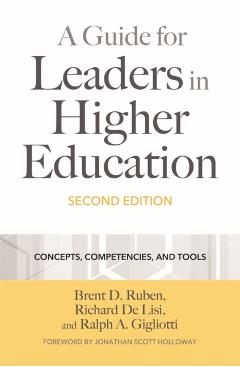
A Guide for Leaders in Higher Education: Concepts, Competencies, and Tools
Fii primul care dă o notă
Despre carte
FIRST EDITION SPECIAL RECOGNITION: Winner of the 2018 Sue DeWine Distinguished Scholarly Book Award, National Communication Association, Applied Communication DivisionREVIEWS OF THE FIRST EDITION The book provides frameworks and resources that would be highly relevant for new and aspiring department chairs. In fact, this text is ideally designed to serve as a selection for a book discussion group.--The Department ChairSucceeds in providing accessible and useful resources to individuals across different leadership roles... As a midpoint between textbook and reference work, it is successful at both and provides a clear and unbiased background to issues facing current leaders.--Reflective TeachingDuring a time of unprecedented challenges facing higher education, the need for effective leadership - for informal and formal leaders across the organization - has never been more imperative.Since publication of the first edition, the environment for higher education has become more critical and complex. Whether facing falling enrollments, questions of economic sustainability, the changing composition of the faculty and student bodies, differential retention and graduation rates, declining public confidence in the enterprise, or the rise in the use of virtual technologies - not to mention how COVID-19 and an intensified focus on long standing issues of racial and gender representation and equity have impacted institutions and challenged many long-standing assumptions - it is clear that learning on the job no longer suffices. Leadership development in higher education has become essential for advancing institutional effectiveness, which is the focus of this book.Taking into account the imperative issues of diversity, inclusion, and belonging, and the context of institutional mission and culture, this book centers on developing capacities for designing and implementing plans, strategies, and structures; connecting and engaging with colleagues and students; and communicating and collaborating with external constituencies in order to shape decisions and policies. It highlights the need to think broadly about the purposes of higher education and the dynamics of organizational excellence, and to apply these insights effectively in goal setting, planning and change leadership, outcomes assessment, addressing crises, and continuous improvement at both the level of the individual and organization.The concepts and tools in this book are equally valuable for faculty
Citește-o cu alții
Fă un club în jurul ei: o împărțiți pe etape, vă bifați progresul și discutați fără spoilere.
Pornește un club cu cartea astaUnde o cumperi
Caut-o și la Cărturești
Prețuri verificate ieri
Linkuri afiliate — susții comunitatea fără costuri extra.
Recenzii
Autentifică-te ca să scrii o recenzie →Nicio recenzie încă. A ta poate fi prima! ✍️